

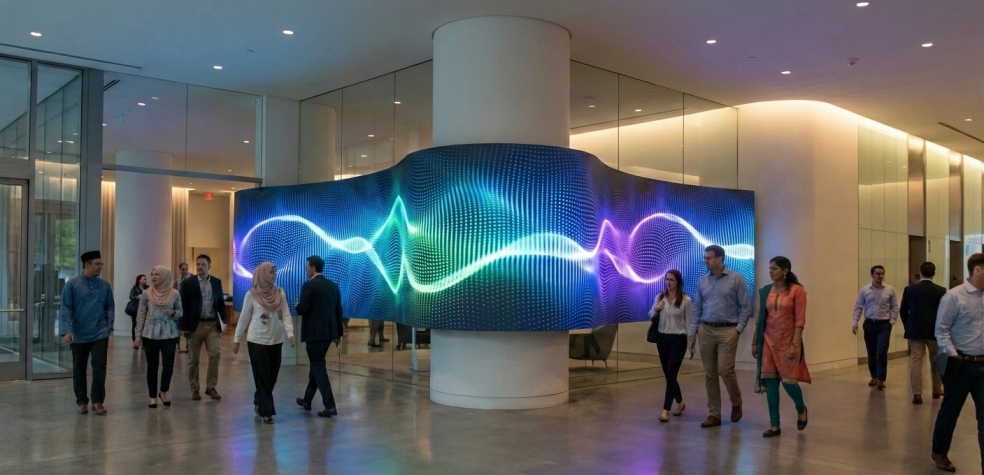
Digital signage has come a long way from the heavy, rigid lightboxes of the past. For decades, screens were confined to flat surfaces and rigid frames. Installers had to adapt their environments to fit the screen. Now, the technology adapts to the environment.
The introduction of the flexible led display has completely changed how architects, marketers, and engineers approach visual communication. These screens can wrap around structural columns, ripple across ceilings, and form immersive, 360-degree viewing experiences. They offer total creative freedom.
However, bending a screen is not as simple as swapping out a plastic casing. Pushing electronic components to flex and curve requires intense engineering. Manufacturers must solve complex problems involving material stress, heat dissipation, and delicate circuitry. This post examines the specific engineering challenges behind bendable screens and the innovative solutions making them a reality.
The Core Challenge: Bendability vs Structural Integrity
Traditional LED panels use rigid printed circuit boards made from fibreglass. These boards provide a stable, flat foundation for mounting thousands of tiny light-emitting diodes. When you attempt to make that foundation flexible, you introduce mechanical stress.
The primary engineering challenge is keeping the electronic connections intact while the screen moves. Every time a display curves, the outer edge stretches while the inner edge compresses. This movement places immense pressure on the solder joints holding the LEDs in place. If the substrate is too stiff, it will snap. If it is too soft, the solder joints will crack, resulting in dead pixels and a ruined image.
To solve this, engineers have moved away from traditional materials and adopted highly resilient polymers. Silicone and specialised rubbers now form the base chassis for these modules. These materials offer the necessary elasticity to absorb movement without transferring that stress directly to the fragile electronic components.
Circuit Design for Dynamic Environments
Finding the right physical chassis is only half the battle. The internal circuitry must also survive the bending process. This requires a complete rethink of how electricity travels across the board.
Flexible Printed Circuit Boards (FPCBs)
Engineers use Flexible Printed Circuit Boards to replace rigid fibreglass. These FPCBs are usually made from polyimide, a polymer film that can withstand high temperatures and repetitive flexing. Polyimide allows the circuitry to bend smoothly without breaking the microscopic copper traces that carry data and power.
Advanced Component Layouts
To further protect the display, engineers strategically alter the layout of the components. Instead of placing parts tightly together, they create microscopic gaps between the rigid LEDs and the flexible board. Some designs incorporate a segmented approach, where small clusters of LEDs sit on tiny rigid islands connected by flexible copper bridges. When the screen bends, the bridges absorb the movement, leaving the islands perfectly flat and secure.
Where Bendable Screens Shine
With the engineering challenges solved, these displays are finding their way into highly creative spaces. Their lightweight and malleable nature opens up entirely new avenues for installation.
Retail and Visual Merchandising
High street retailers use curved screens to capture attention in crowded shopping centres. A display that seamlessly wraps around a corner or a central pillar turns structural obstacles into dynamic digital canvases. Store designers can create fluid, moving walls of colour that draw customers inside.
Architectural Integration
Modern architecture often features sweeping curves and organic shapes. Flat screens disrupt these designs, but flexible modules harmonise with them. Architects embed these screens into curved reception desks, vaulted ceilings, and circular bulkheads. The technology blends into the building itself, making the digital elements feel like a natural part of the physical structure.
Creative Branding and Live Events
Exhibition stands and concert stages rely heavily on visual impact. Stage designers use bendable screens to build massive ribbons of video that loop above the audience. Because the modules are lightweight and often magnetic, production teams can snap them together quickly to form custom shapes for single events.
Keeping Non-Rigid Hardware Running
A screen that bends requires different maintenance protocols than a screen that sits flat against a wall. The materials that make the screen flexible can sometimes complicate its long-term upkeep.
Heat dissipation is a major factor. Traditional rigid displays use aluminium cabinets to draw heat away from the electronics. Silicone and rubber, however, are insulators. They trap heat. To prevent the LEDs from burning out, engineers design these flexible modules with specialised heat-conducting backing layers and rely on careful power management to keep temperatures low.
Longevity also depends on the installation method. Most flexible modules use powerful magnets to attach to a custom metal framework. This magnetic system is highly beneficial for maintenance. If a section of the screen gets damaged, technicians can pop the specific module out from the front and replace it within seconds, without dismantling the entire installation.
The Future of Malleable Visual Technology
Flexible digital signage has fundamentally shifted our expectations of digital environments. We are moving away from the era of flat rectangles and entering an age where video can map to any surface, shape, or structure.
As material science improves, these displays will become even thinner, brighter, and tighter in their bend radius. Organisations looking to make a lasting visual impact should consider how this technology can transform their physical spaces. By understanding the engineering behind the curve, designers and business owners can push the boundaries of what is visually possible.